This edition of “24hrs in…” is certainly different from the others, as there will be no hotel taking centre stage, but rather an entire city. I had the opportunity to visit Poitiers, a small city in western France, last September for academic reasons. I must say, it was truly worth the journey. There is something about its atmosphere that makes it remarkably unique.
First of all, getting to Poitiers is part of the experience itself. The easiest option is to fly directly to Paris Charles de Gaulle and then take the TGV to Poitiers. In just over two hours, the French high-speed train carries you from the capital to the city.
And then comes the surprise.
Although Poitiers is surrounded by the gentle landscape of the French countryside, the city itself rises dramatically on a hill approximately 180 metres above sea level. As I arrived in September, the weather was particularly mild, and the soft autumn air seemed almost to embrace the old stone buildings.
It was my first impression of Poitiers, and one that stayed with me.
The city does not reveal itself immediately. It needs to be discovered slowly, street after street, building after building. And perhaps this is precisely what makes it so fascinating.
A city written by history
Poitiers is not simply an attractive provincial French city. Its history stretches back more than two thousand years, and almost every corner of its historic centre seems to carry a different chapter of it.
Long before the medieval city took shape, the area was inhabited by the Pictones, a Celtic people who gave the region its name. Under Roman rule, their settlement became known as Limonum and developed into an important centre of the province of Gallia Aquitania.
The strategic position of Poitiers explains much of its later history. Built on a promontory between the valleys of the Clain and the Boivre, the city offered both protection and control over the surrounding territory.
And this strategic importance repeatedly brought Poitiers into the centre of European history.
In 507, not far from the city, the Frankish king Clovis I defeated Alaric II, king of the Visigoths, at the Battle of Vouillé. The victory played an important role in the expansion of the Frankish kingdom and the gradual establishment of the political entity that would eventually become France.
Two centuries later, Poitiers would once again lend its name to one of the most famous battles of the early Middle Ages.
In 732, Charles Martel confronted an Umayyad army in what became known as the Battle of Tours or Battle of Poitiers. Although historians continue to debate the precise location, scale, and significance of the confrontation, its symbolic importance became deeply embedded in European history.
Walking through Poitiers today, these events seem almost impossibly distant.
And yet, this is precisely what I found so fascinating: the contemporary city is built directly on top of these layers of history.

Eleanor of Aquitaine's Poitiers
If there is one historical figure who seems to accompany you throughout Poitiers, it is undoubtedly Eleanor of Aquitaine.
Born around 1122, Eleanor became Duchess of Aquitaine, Queen of France, and later Queen of England. She was one of the most powerful women of medieval Europe, and Poitiers was one of the principal centres of her political and cultural life.
Her connection with the city is still visible today.
The Palais des Comtes de Poitou, the former residence of the Counts of Poitou and Dukes of Aquitaine, remains one of the most important historical buildings in the city. Its immense medieval halls offer an extraordinary sense of the political importance Poitiers once held.
Eleanor's Poitiers was a city of power, but also of culture.
Her court became associated with the flourishing of troubadour culture and the sophisticated courtly traditions of medieval southern France. The city was not simply a political centre; it was a place where literature, music, and ideas circulated.
It is difficult not to imagine what Poitiers must have looked like in the twelfth century.
The same streets that today are filled with cafés, shops, and students were once crossed by nobles, clerics, merchants, and courtiers.
And then there is the Cathédrale Saint-Pierre, another extraordinary reminder of that period.
The cathedral was begun in the twelfth century under Eleanor and her husband, Henry II of England. Its monumental scale reflects the importance of the Plantagenet dynasty and of the territories they controlled across France and England.
Inside, one of its greatest treasures is the enormous twelfth-century stained-glass window depicting the Crucifixion. At the bottom of the composition appear Eleanor and Henry II with members of their family, and history suddenly stops being abstract.
Notre-Dame-la-Grande

From the cathedral, I would continue towards Notre-Dame-la-Grande, perhaps the most recognisable image of Poitiers.
The Romanesque church (which is now under renovation until mid-2027) dates mainly from the eleventh and twelfth centuries, and its extraordinary western façade is covered with sculptures depicting biblical scenes and figures.
It is one of those monuments that becomes more interesting the longer you look at it.
The façade was not designed simply to be beautiful. In a medieval society in which literacy was limited, these sculptures helped communicate biblical stories to the population.
Every figure had a purpose. Every detail told a story.
And perhaps this is one of the reasons Poitiers feels different from other French destinations. The architecture is not merely decorative. It is a record of how people once understood the world.
Joan of Arc in Poitiers
But Eleanor is not the only remarkable woman whose story is connected to the city.
In 1429, Joan of Arc came to Poitiers.
Before meeting Charles, the future King Charles VII, Joan was examined by a commission of theologians and clerics. The purpose was to determine whether the young woman claiming to have received divine instructions should be trusted.
The examination took place in the city, and the commission ultimately found nothing that prevented her from continuing her mission.
From Poitiers, Joan travelled towards the Dauphin and the events that would transform her into one of the most famous figures in French history.
It is an extraordinary detail of the city's history.
Two women separated by almost three centuries — Eleanor of Aquitaine and Joan of Arc — both passed through Poitiers at crucial moments in European history.
The Hôtel de Ville
This transition from the historic city to modern Poitiers becomes particularly visible at the Hôtel de Ville, the city's Town Hall.
Built between 1869 and 1875, the building stands on the central Place du Maréchal-Philippe-Leclerc and is one of the most imposing examples of nineteenth-century architecture in Poitiers. Designed by the architect Antoine-Gaétan Guérin, its monumental Neo-Renaissance façade, towers, and sculptural decoration were intended to reflect the confidence of a city entering a new era.
Inside, however, history once again takes centre stage.
The Salle des Mariages is decorated with monumental paintings by Pierre Puvis de Chavannes, dedicated to episodes from the history of Poitiers. But what moved me most was a detail that I had the privilege of seeing up close: the stained-glass window depicting Eleanor of Aquitaine, represented as she confirms the city's municipal charter in 1199.
Being able to stand so close to the glass and observe its details was genuinely emotional. Eleanor is not simply a distant historical figure in Poitiers; her presence is woven into the identity of the city, and seeing her represented in this intimate and remarkably beautiful work made the connection feel unexpectedly tangible.
It is perhaps the perfect image of Poitiers itself: an extraordinary piece of medieval history preserved within a nineteenth-century civic building, reminding us that in this city, the past is never really past.
A city of knowledge
But Poitiers is also a university city, and this gives it a completely different atmosphere. Today, out of 90.000 inhabitants, 30.000 are university students.
The University of Poitiers was founded in 1431, making it one of France's oldest universities. For centuries, students have arrived here to study law, theology, medicine, and the humanities.
This academic tradition is still very much alive.
Walking through the centre today, the presence of students prevents Poitiers from feeling like a city frozen in its medieval past. The university occupies historic buildings, while contemporary academic life takes place alongside centuries-old architecture.
One of the best examples is the Hôtel Fumé, an extraordinary late Gothic and Renaissance building that now forms part of the university (faculty of social sciences and humanities).
It is one of those places where Poitiers becomes almost surreal.
You can be walking through a building that looks like it belongs to a medieval novel and suddenly realise that it is, in fact, a functioning university.
This coexistence between past and present is perhaps the defining characteristic of the city.
Beyond the Middle Ages
To understand Poitiers, however, it is important to move beyond its medieval identity.
The Musée Sainte-Croix offers precisely this opportunity.
Housed in a striking modernist building dating from the 1970s, the museum contains collections ranging from archaeology to modern and contemporary art.
Among its highlights is an important collection dedicated to Camille Claudel, whose sculptures provide another, very different connection between Poitiers and French cultural history.
I particularly enjoyed the contrast.
Outside, the city appears dominated by Romanesque churches, medieval streets, and Renaissance façades, while inside the museum, the language suddenly changes: modern architecture, sculpture, and contemporary culture enter the picture.
Walking through the city
The best way to experience Poitiers is therefore not necessarily to follow a strict itinerary but to walk.
The historic centre is compact enough to explore on foot, and every street seems to reveal something unexpected.

Grand'Rue is particularly beautiful, with its medieval houses, Renaissance façades, and small independent shops (many of them vintage shops). It is one of the oldest streets in the city and has traditionally been one of its main commercial arteries.
Today, it retains that sense of movement.
There are cafés, boutiques, artisans, and small businesses occupying buildings that have been part of the urban fabric for centuries.
This is where I began to understand that Poitiers' charm is not really about monumental grandeur: it is about details, a stone doorway, a carved façade, a small courtyard, a shop window, a student sitting outside a café beneath a building that was already standing hundreds of years ago.
Where to Eat
La Table des Copains
For a contemporary take on French cuisine, La Table des Copains is an address worth discovering in the heart of Poitiers. The atmosphere is relaxed but refined, while the menu focuses on seasonal ingredients and generous, carefully prepared dishes. What I particularly liked is that it does not try too hard to be fashionable: the experience feels genuinely French, contemporary without losing its connection to tradition. It is the kind of restaurant where I would happily linger over lunch or dinner, allowing the meal to become part of the experience of discovering the city.
Le Comptoir du Marché
For a more spontaneous and local experience, I would choose Le Comptoir du Marché, located on Place Charles de Gaulle, just beside Notre-Dame-la-Grande. The name itself says a lot about its philosophy: the restaurant is closely connected to the market and to the idea of seasonal, locally sourced produce. Its changing menu, selection of regional products and wines from independent producers make it a particularly enjoyable place to stop during the day. I would recommend it for lunch, when the square and the surrounding streets are at their most lively, and when you can really feel the everyday rhythm of Poitiers.
Les Archives
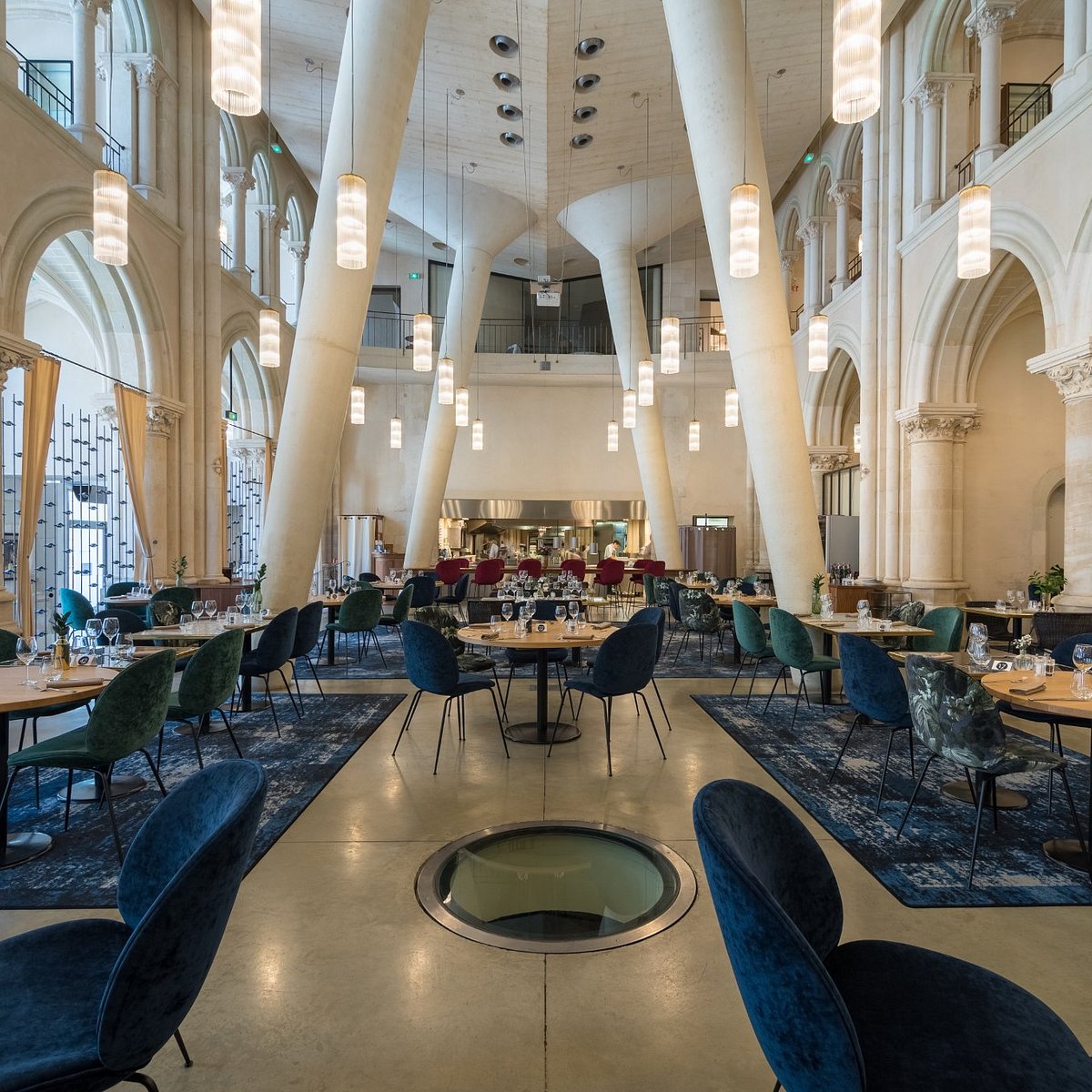
For dinner, Les Archives is perhaps the most memorable choice. Set inside a former Jesuit chapel, the restaurant combines contemporary French cuisine with one of the city's most extraordinary settings. The vaulted ceilings, stone walls, and monumental architecture create an almost theatrical atmosphere, while the cuisine remains elegant and firmly rooted in French tradition. Here, the setting is as important as what is on the plate. After a day spent discovering Poitiers through its history and architecture, there is something particularly fitting about ending the evening beneath the arches of a building that has witnessed centuries of the city's story.
Our Take from Poitiers
After spending a full day in Poitiers, what struck me most was the way its different historical periods coexist within the same urban space. Its Roman origins, the medieval city, the period of Eleanor of Aquitaine, the history of Joan of Arc, the university tradition, and the architectural developments of the nineteenth and twentieth centuries are all still visible today.
This is what makes Poitiers interesting to explore. Its historic centre is compact and easy to walk through, but there is considerable variety in its architecture, cultural institutions, and streets. A Romanesque church can stand a few steps away from a Renaissance building, while a university department occupies a historic residence and a modern museum introduces contemporary art into the same urban landscape.
There is also a particular atmosphere to Poitiers that I appreciated during my stay. The city feels calm and relaxed, but at the same time distinctly cultured. The presence of the university contributes to this character, with students, academics, bookshops, cafés, cultural institutions, and historic buildings all sharing the same relatively compact centre. It gives Poitiers a quiet intellectual quality without making it feel formal or overly academic.
I particularly appreciated this continuity between the past and the present. The history of Poitiers is not confined to its museums or monuments; it remains part of the city's everyday life and can be seen in the buildings, streets, and institutions that continue to shape the city today.
Poitiers is a city that rewards time and curiosity, particularly if you take the opportunity to look beyond its best-known monuments and discover the different layers of its history. It is calm without being sleepy, cultured without being pretentious, and historic without feeling stuck in the past.
Perhaps this is what makes Poitiers so memorable: after 24 hours, you leave having seen a city with two thousand years of history — and yet, somehow, it feels as though its most interesting chapter is still being written.
related posts
Travel & Living
The New Luxury: Why 2026 is the Year of Purpose-Driven Travel