#INTERVIEW: Norman Mabire-Larguier | Contours of Silence
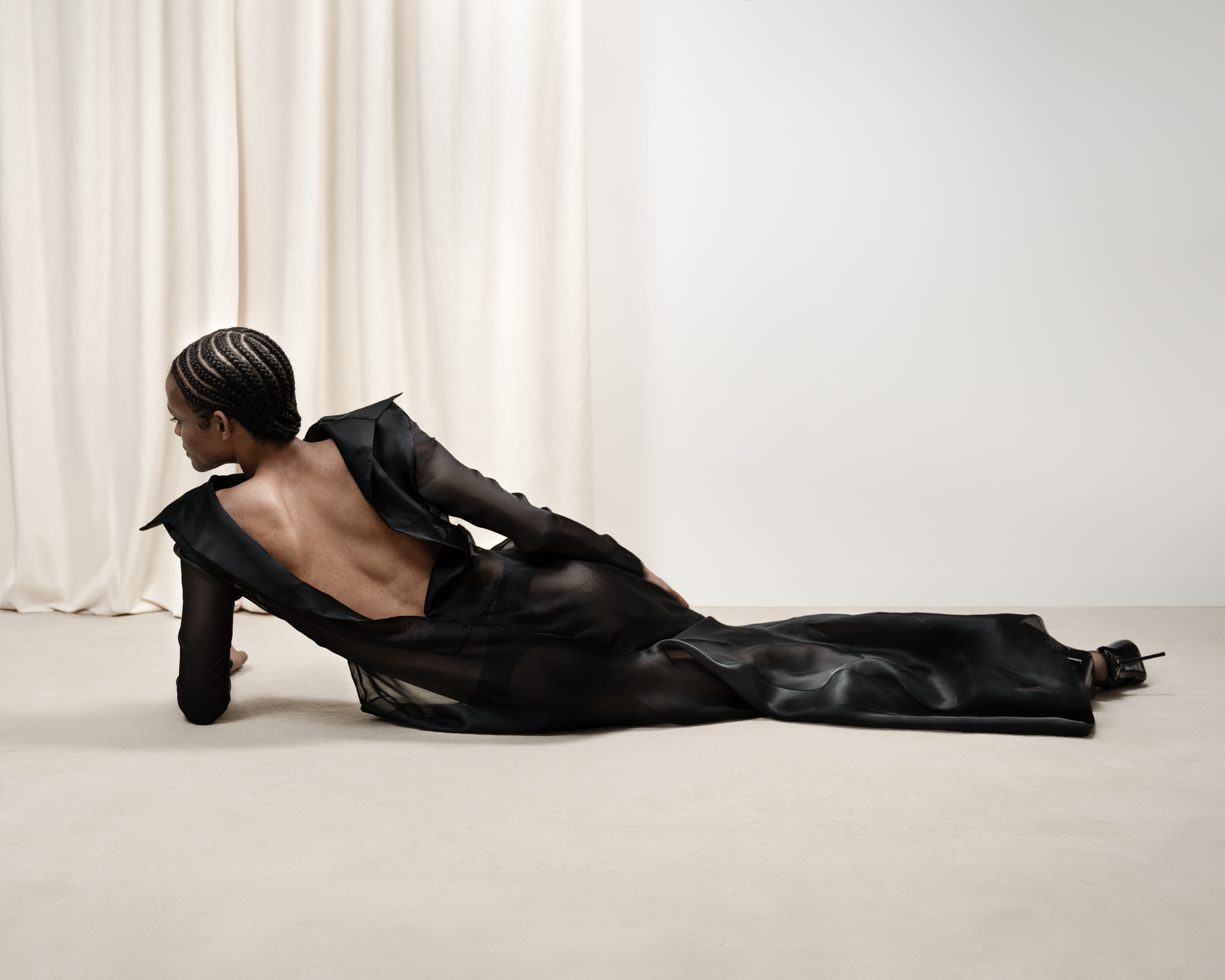
During Haute Couture Fashion Week in Paris, I visited Norman Mabire-Larguier’s intimate showroom, where he presented his Fall–Winter 2025 Couture collection. The presentation unfolded as a study in emotion, purity, and the architectural discipline of each garment. Conceived as an exclusive exhibition, it felt like a dialogue between fabric and form, silence and sensuality, and the interplay of light and black.
Through his reflections, Mabire-Larguier reveals a practice rooted in emotion, meticulous craftsmanship, and a profound respect for the human experience of clothing. The interview that follows offers a portrait of a designer who treats couture as a space of introspection, intimacy, and personal connection.
Tanja Beljanski: Haute couture is often described as the ultimate expression of intimacy between designer, garment, and wearer. For you, how does couture allow a connection that ready-to-wear cannot?
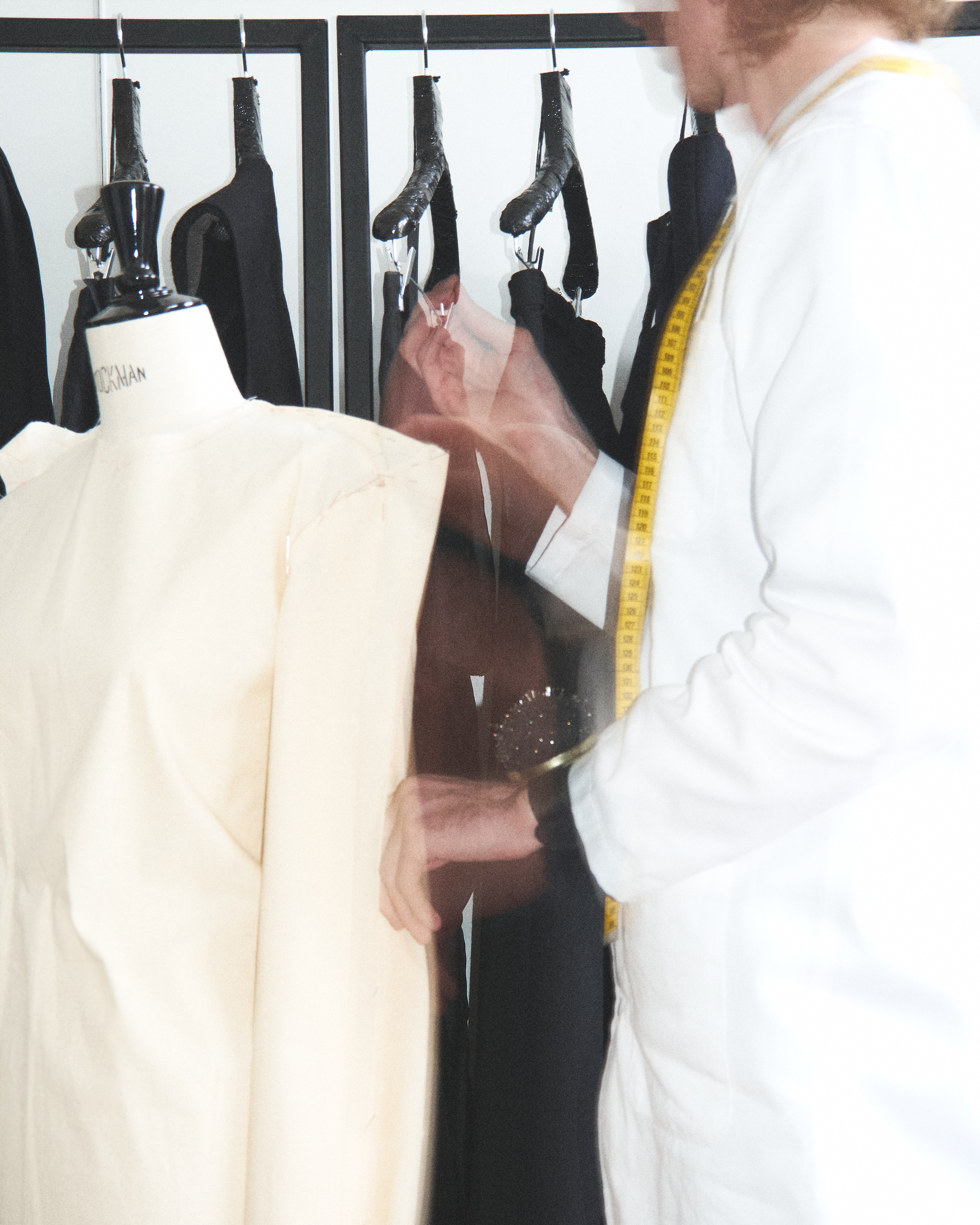
Norman Mabire-Larguier: As an independent couturier, genuine human connection holds enormous value for me. Ready-to-wear follows a one-directional format that places the garment before the individual. Couture functions differently. Each piece emerges from an exclusive exchange between the wearer, the couturier, and the material. It becomes a personal journey shaped by time, silence, and attention. I involve myself in every step of the process. Observing how a person moves, understanding how they feel, and drawing inspiration from their attitude creates an alchemy that is essential. Ultimately, the wearer brings the piece to life. They activate the emotions that I have woven into each garment. That is the true beauty of couture.
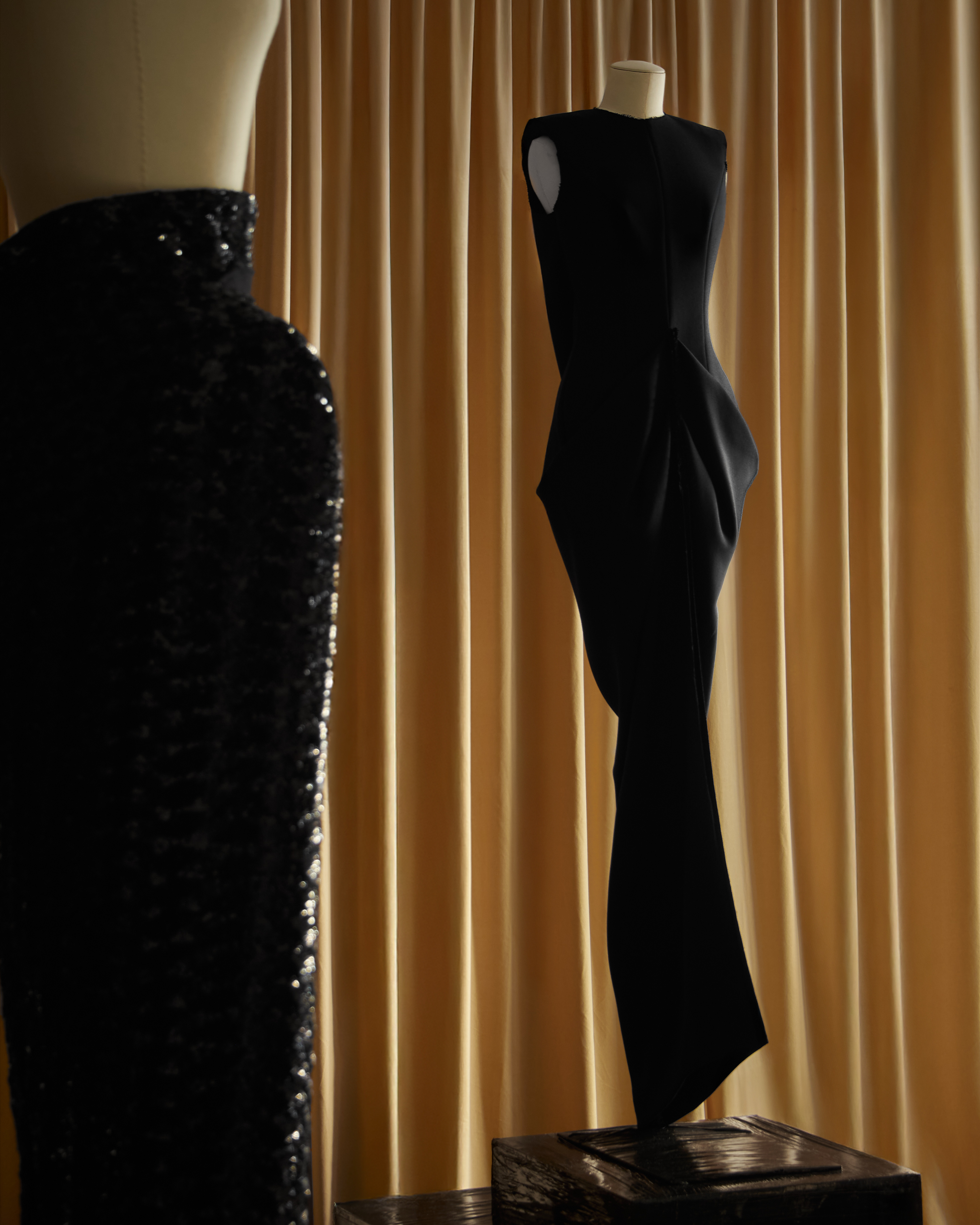
Your Fall–Winter 2025 Couture collection was presented in an intimate salon. What role does emotion—and even introspection—play in your creative process?
Emotion is the foundation of my work. I don’t think in terms of seasonal themes; instead, I develop a continuous body of research. My intention is to translate very personal emotions into form, giving shape to my inner world without compromise. Fabric and emotion are inseparable—the nervous fall of wool twill, a draped open back that reveals the body through movement, or a sheer silk organza that behaves like a chrysalis, fragile and protective at once. Presenting the collection in an intimate salon, within the historic building that houses our atelier, felt essential. It allows time—to meet, to exchange, to feel. Guests can approach the pieces up close, try them during private appointments, and experience them from within. This creates a deeply sensitive dialogue between cut, material, and emotion.
You often speak about reducing garments to pure, almost abstract forms. What draws you to abstraction, and how do you know when a piece has reached balance?
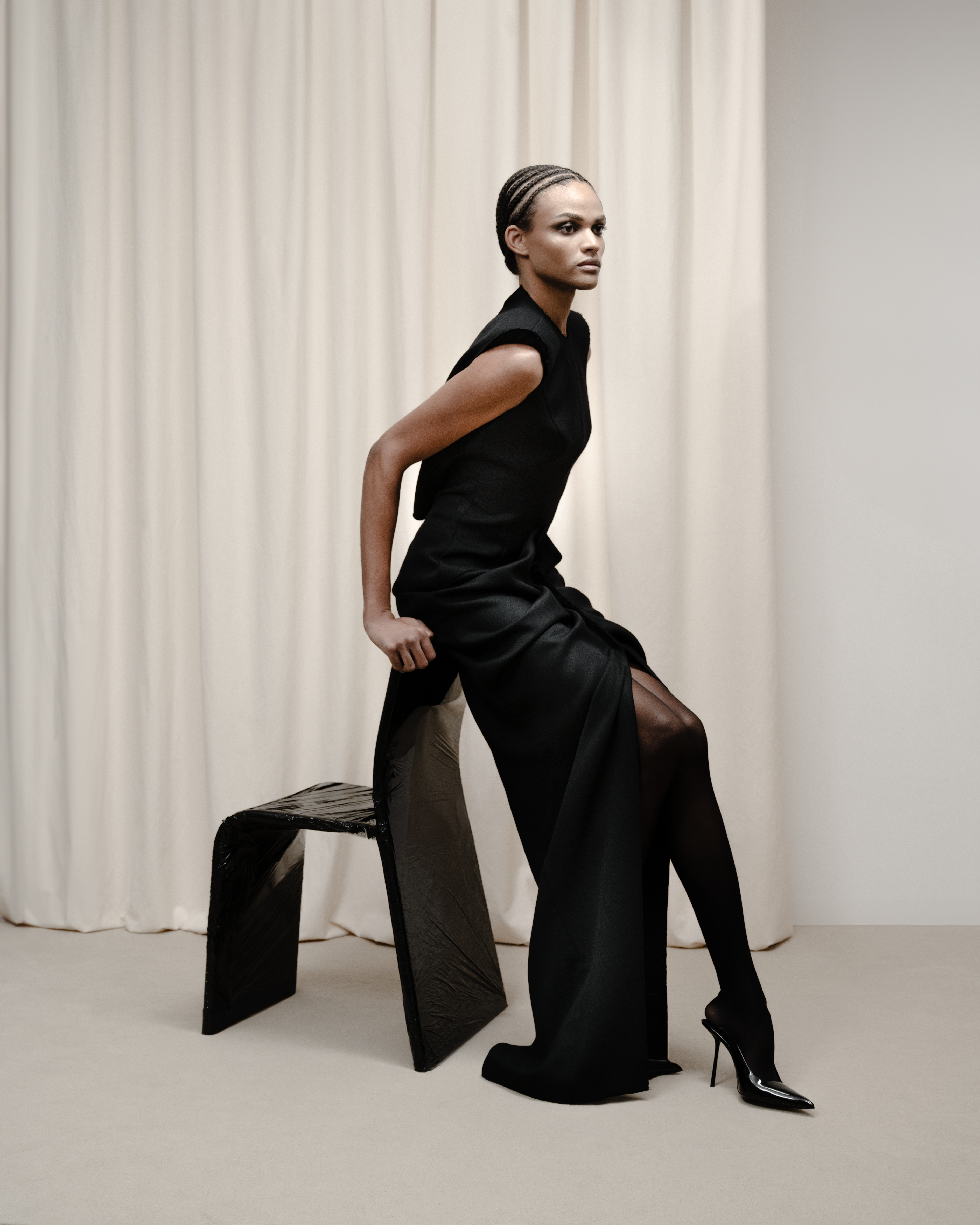
Abstraction emerges from the search for essence—pushing a form to its limit until it transcends the conventions of clothing. It is a way to redefine what a garment can become, liberated from traditional codes. Simplicity is often the most challenging pursuit. Each piece results from demanding technical work. I aim to transform emotion into a gesture of pure cut, stripped to its essential form. Lately, I have been exploring garments composed only of front and back panels which, once assembled, create the entire silhouette. It is a radical exercise in épure, refining the dialogue with the body to its core. At the same time, my pieces are deeply tangible. They are crafted from noble materials, constructed by hand, and meant to live and move.
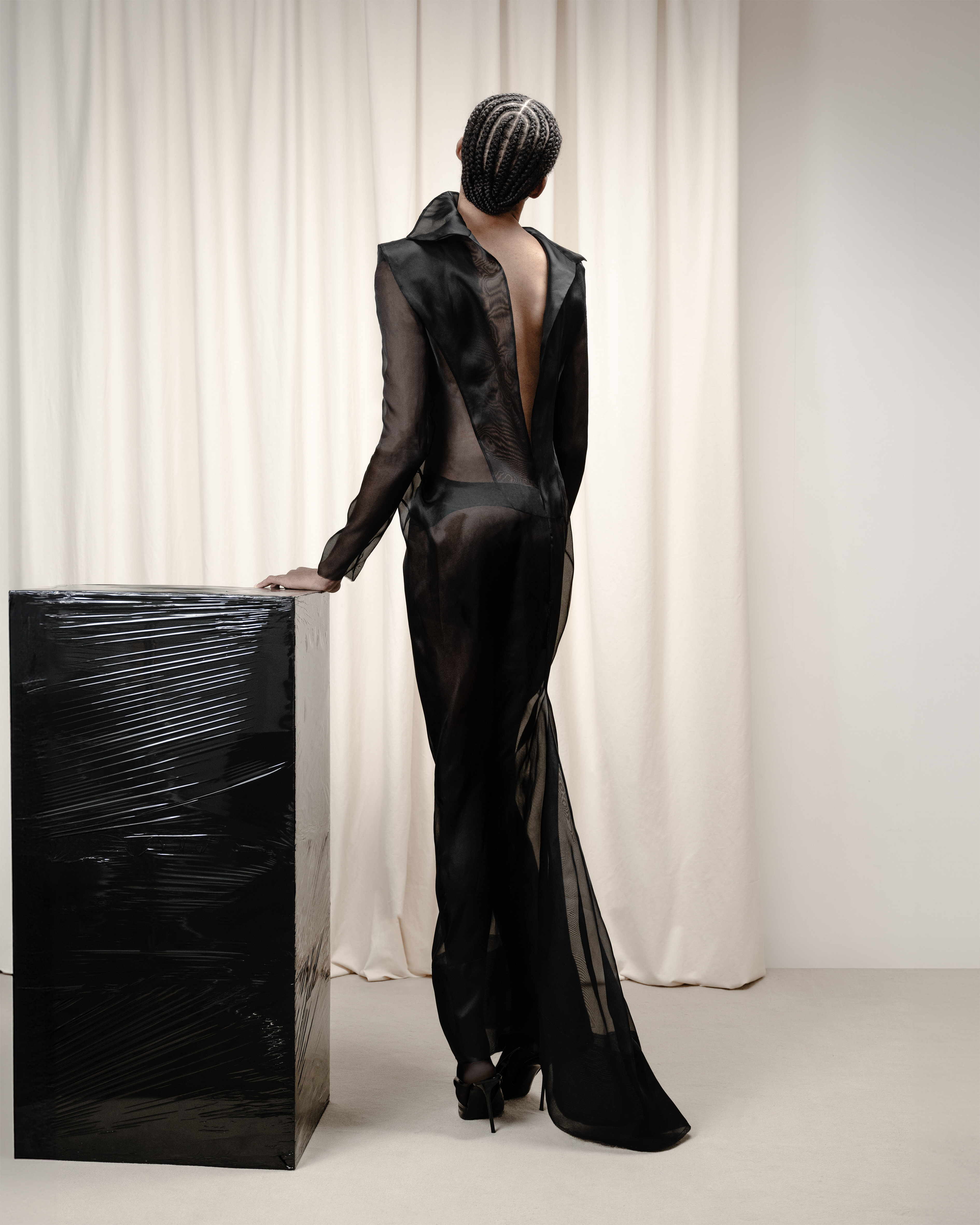
There is a quiet sensuality in your work. How do you approach sensuality in couture today, especially in a culture of overexposure?
My work expresses a tension between austerity and sensuality. Instead of creating pieces that restrict the body through heavy structures, I sculpt with the body itself. A section cut on the bias follows the body's contours; a draped slit reveals the back through movement; a sheer silk organza unveils the skin with discretion. For me, sensuality resides in the back—an area where fragility and presence meet. I am interested in the sensuality of material rather than ornamentation. Without aiming to expose, this approach produces a quiet and powerful form of sensual expression.
Black has become your signature, and in your hands it feels alive. What does black represent for you, and how do you see light as its counterpart?
I use black as a radical statement—quiet, powerful, and precise. It allows me to refine each silhouette to its essence. Black is not simply a colour; it is a medium through which I explore the relationship between light and matter. A matte wool felt absorbs light completely. Sequinned gloves reflect it like water. A sheer organza reveals the skin with a slight shine. French seams and pleated techniques create a graphic rhythm that enhances construction. Through these contrasts, black becomes a language.
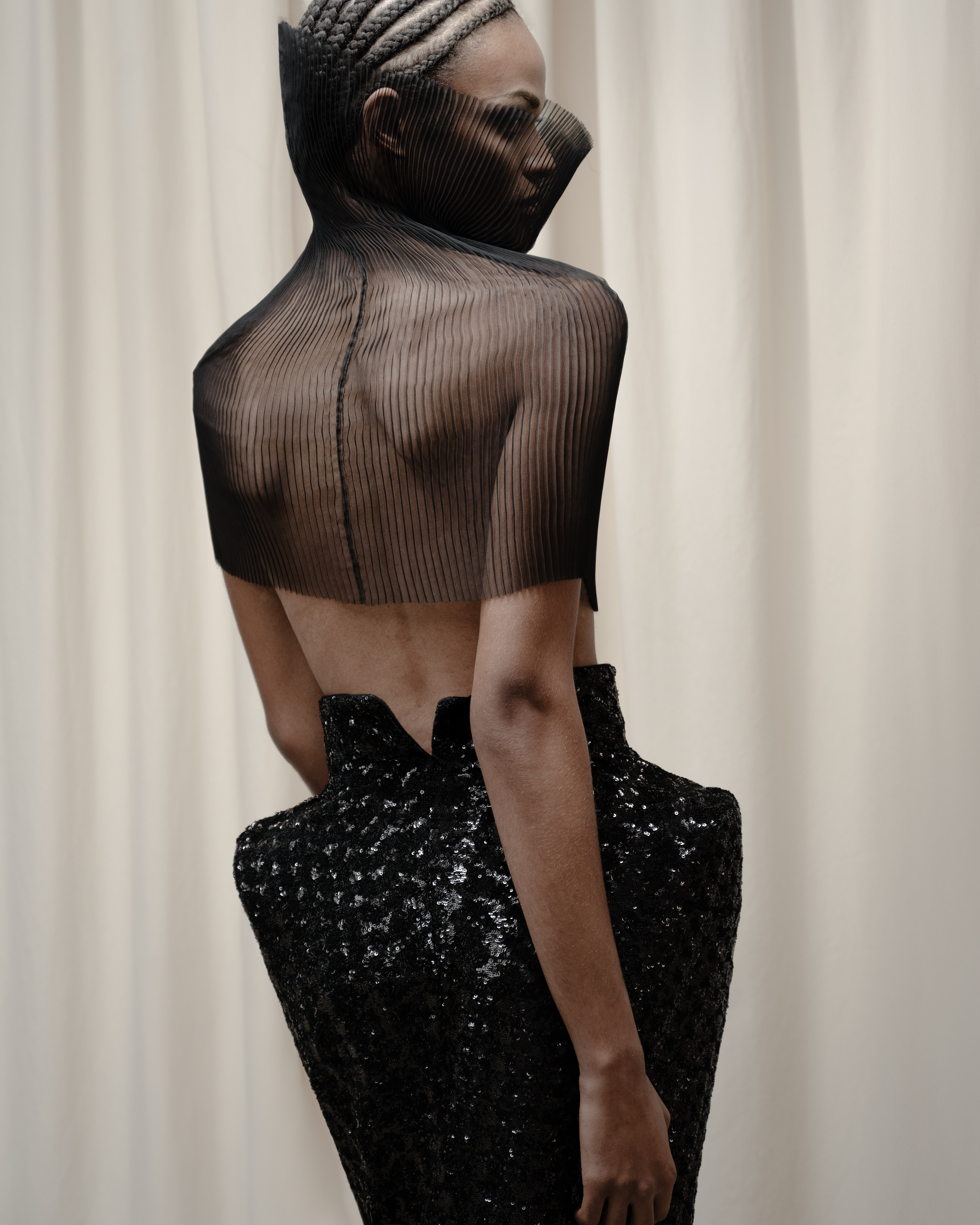
You refine each silhouette over weeks. In a world moving at high speed, what does time mean to you in couture?
Couture exists in another temporal dimension. I am not trying to produce the greatest number of pieces, but to create garments that are meaningful and executed with precision. Each piece requires weeks of research and development—pattern-making, draping, toiles, fittings, sourcing the right fabric, cutting, sewing, and meticulous hand-finishing. Everything is made by hand in our Paris atelier. We are a small team, and we focus only on pieces that carry deep intention. I have never abandoned a design. I refuse to compromise. I work until a piece feels resolved. Sometimes I must step away and return later with renewed clarity. It has to feel inevitable.
Couture is a dialogue with the client. How do you imagine the person who wears your work?
You cannot present a strong point of view by trying to please everyone. My work resonates with people who connect with its sensibility and radicality. Meeting clients who feel this connection on a personal level is one of the greatest joys of this practice.I often say that I work on a body, not a gender. In couture, everything is created for a specific person. I love that men come to us seeking a sensitivity they do not find elsewhere in couture. These relationships matter profoundly. Clients do not come to us by accident. I accommodate them however I can—fittings in their hotel, traveling to meet them, or welcoming them in the atelier to experience the craft behind each piece. We are even considering our first trunk show, conceived as an intimate moment in a special location.
Your work is rooted in tradition but speaks in a modern voice. How do you see the future of couture as art, emotion, and innovation continue to evolve?
Modernity is central to my work. While I am drawn to certain traditions of couture, especially in craftsmanship, I am not living in a past I never knew. My aim is to articulate a forward-looking vision of what couture can be today. This guides both creative and strategic decisions. Following your own path requires resilience. When I began, I was advised to focus on ready-to-wear and treat couture as a mere showcase. Today, as the industry transforms, staying aligned with my values feels increasingly relevant. Couture was once seen as a remnant of history, but I am deeply convinced that it is the future of fashion.
Team Credits:
Talent: Mathias Lamin @mathiaslamin
Photographer: Mathilde Lesueur @mathildelesueurr
Image Direction: Clément Grahn @clement.grahn
Make-up Artist: Chloé Kozak @chloe.kz
.jpg)
.jpg)