One Year Without Armani
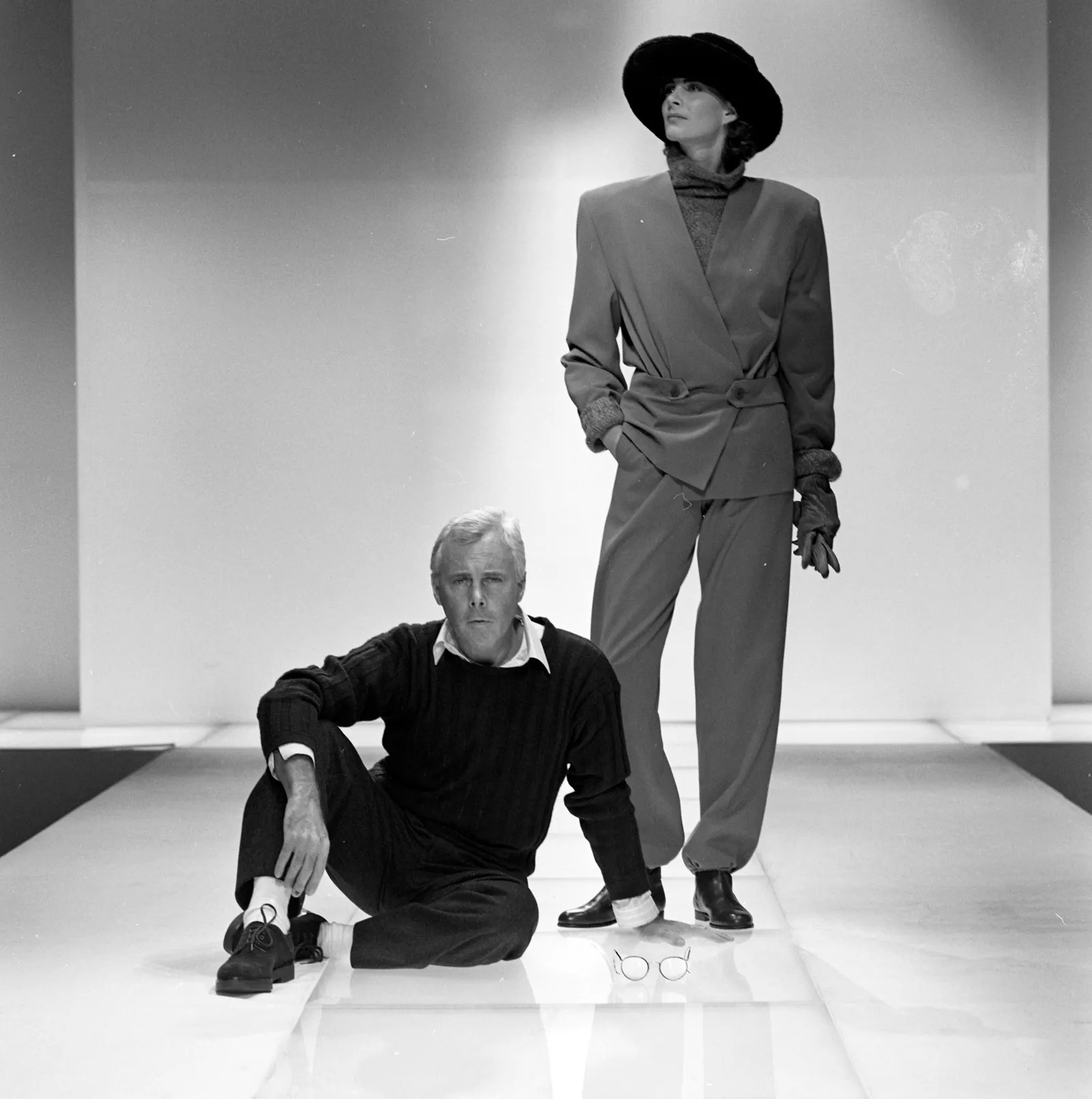
One year ago, the fashion world came to a standstill for a moment. The passing of Mr. Armani marked not only the end of one of the most important stories in Italian fashion, but also left behind a silence that is difficult to fill — the kind of silence that follows the presence of a figure who, for decades, became much more than a designer.
Looking back at Giorgio Armani today, perhaps the word that best captures his legacy is coherence. Not coherence understood as immobility, but as the ability to evolve without betraying one’s essence. It is precisely this concept that I tried to explore last year (read it here), reflecting on how Armani had built, over fifty years of fashion, a recognisable universe while continuing to explore different worlds, forms and languages.
His apparent simplicity was never synonymous with a lack of expression. On the contrary, that simplicity became a structure capable of embracing everything: fashion, haute couture, design, fragrance and hospitality. A true Armani universe, in which different disciplines could coexist while maintaining the same perspective. From collections inspired by Japan and India to Armani/Casa, from essential forms to more opulent and decorative elements, coherence emerged precisely through multiplicity.
And then there is the present. Because one year without Armani also means looking at the people who are now carrying his vision forward: Silvana Armani and Leo Dell’Orco. Their work over this first year deserves recognition. They have approached this new chapter with great sensitivity, showing that protecting an extraordinary legacy does not necessarily mean keeping it unchanged.
What they are doing is perhaps the most delicate task of all: continuing a language that belongs so deeply to one person while allowing it to breathe through a new generation. There is respect for what Giorgio Armani created, but also the awareness that a living brand cannot simply stand still. It has to move, interpret the present and continue to speak to its time.
And this is where, one year later, I believe the real strength of Armani becomes visible. His greatest legacy may not be a particular silhouette, a collection or even a specific aesthetic code, but the idea that identity can survive change. Armani taught us that consistency is not about repeating oneself; it is about knowing what should never be lost, even when everything around it evolves.
Perhaps this is why “one year without Armani” feels like an unusual expression. We can speak of his absence as a person, but it is much harder to speak of an absence in the world he created. His vision continues to be present in the clothes, in the spaces, in the objects and in the people who are now responsible for taking it forward.
A year later, the question is therefore no longer simply what Armani means without Giorgio Armani. It is what Giorgio Armani has made possible after Giorgio Armani. And perhaps the answer is already taking shape: an identity strong enough to continue, evolve and remain unmistakably itself.