The Geometry of Light
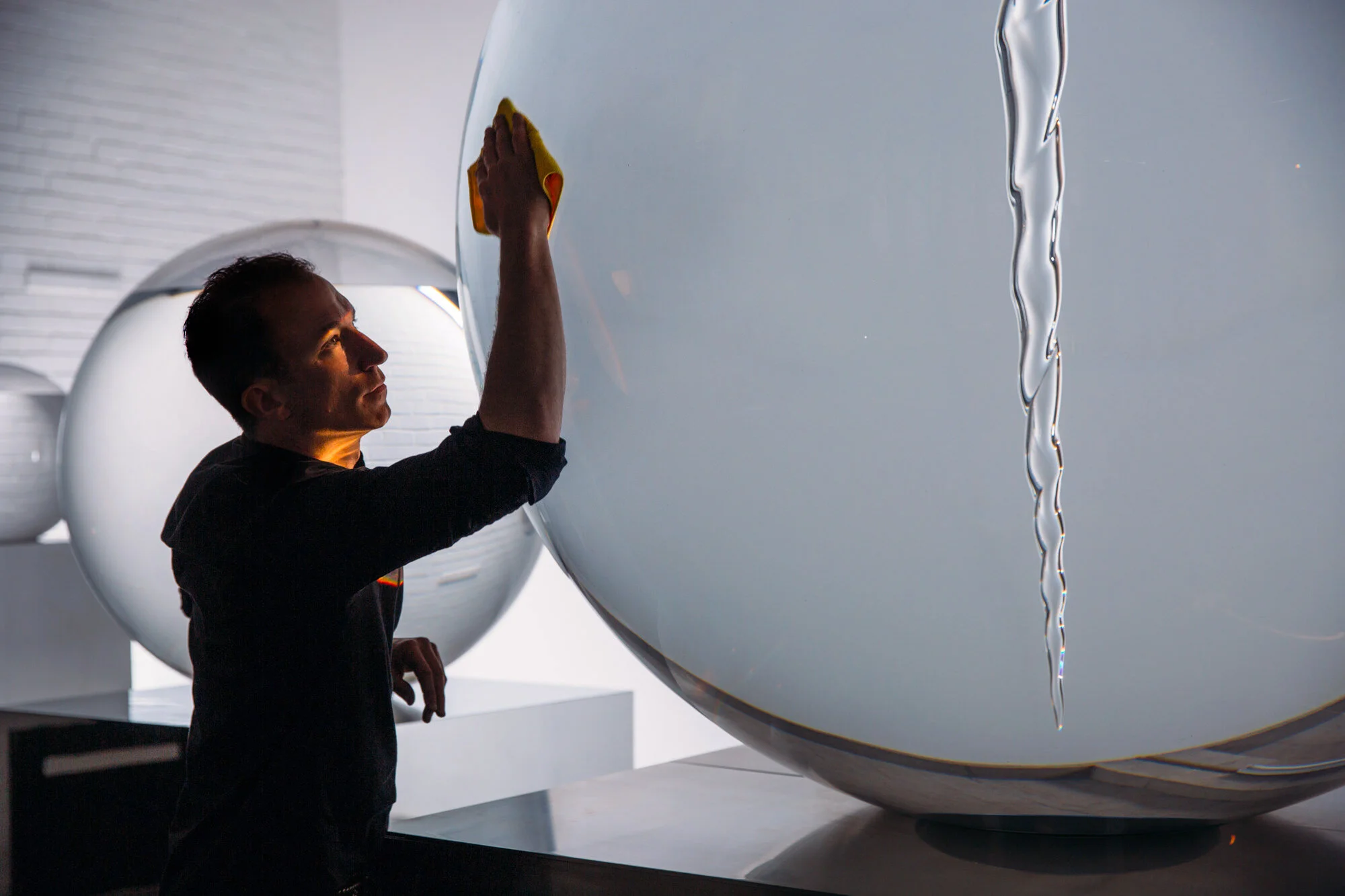
In the sun-kissed lobby of the Four Seasons Doha, British artist Petroc Sesti reflects on a decade of artistic evolution in the Middle East, brought to life through a special activation hosted by the hotel. Born in London, where he continues to live and work, Sesti has built a practice that consistently pushes the boundaries between high art and high science. Known for his liquid vortexes, vast optical lenses, and complex light mappings, his work explores the ever-changing relationship between artwork, the viewer, and the space in which it is placed. With Four Seasons Doha at the helm of this immersive presentation, his latest activation, Tracing the Void, transforms the hotel into a site of discovery, bringing the mysteries of the Milky Way down to earth.
Delna Mistry Anand: Stepping into the lobby of Four Seasons Doha, we're greeted by your monumental optical piece HELIOPHORE II and now we have Tracing the Void. How does presenting these works within a hotel setting shape their presence and the way people experience them?

Petroc Sesti: Showcasing artwork at Four Seasons Doha brings a very different energy to the installation. Hotels are living spaces where people pass through, pause, observe and interact in an organic way, that movement becomes part of the artwork itself.
HELIOPHORE II is my largest and most ambitious prism to date, I think of it as a living sun clock. Ideally it should be placed outdoors, as it captures and disperses the intense Doha sunlight into shifting spectral fields that move along with the viewer. As you walk through the hotel lobby, the light changes constantly, it reveals the anatomy of sunlight and the beauty of the darkness that defines it. It’s a fully responsive experience shaped by movement, environment, and time.
Tracing the Void responds to the viewer’s presence, so placing it in a space like this allows it to constantly evolve. Four Seasons Doha has created an environment where art can exist beyond the gallery, becoming part of everyday experience. Guests encounter it unexpectedly, and that moment of discovery makes the connection more personal and memorable.
How does it feel to return to Doha as the city hosts the region’s first ever chapter of Art Basel?
It’s nothing short of extraordinary. When I first arrived to install my work at the Qatar Foundation, years ago, the desert summer heat was so visceral it practically became part of the process. Since then, I’ve watched this region blossom into the sophisticated metropolis it is now, where the art and culture scene is constantly growing. Now, with the GCC actively investing in science, art and architecture, and Doha having hosted the region’s first ever Art Basel, it feels like a continuation of that momentum.
Has the Gulf influenced your aesthetic in any way?
My initial immersion into Islamic culture began in Morocco as a child, but Qatar took it to the next level for my work. I’ve always been fascinated by the limitations imposed by tradition; the move away from figurative representation toward the infinite beauty of geometry and mathematics feels deeply poetic to me. There is also something very fascinating about the way ancient pearl divers used the stars for navigation; that connection between the human experience and the fixed stars resonates with my own fascination with celestial mapping.
You’ve spoken about ‘natura morta’, which is the idea of static art. Why is motion so central to your practice?
Most traditional art is static, and to me that feels unnatural. The world is in a constant state of movement. Clouds shift, waves move, even the particles around us are always in flux. I chose the vortex as a medium because it allows me to contain a living force within a sculpture. It’s essentially a void surrounded by motion. It brings us back to the galactic core, a black hole at the centre of everything, spinning in silence.
My work Vanishing Point has been spinning in this city for fourteen years without pause. It is placed at the Qatar Foundation, and has become part of the local architecture, a constant reminder of that liquid energy.
It is so interesting and almost poetically ironic how rooted in science, your art is. Tell us about this unique collaboration?
Since my early years, I’ve always been interested in pushing the boundaries between those two worlds. I’ve collaborated with scientists from space programs and with forestry researchers laser scanning trees in rainforests. These collaborations ground my ideas in physical reality. My sculptures and paintings engage the location and movement of the viewer through optical lenses and Moiré geometries. They reconfigure the landscape in real time and offer a unique, responsive interaction. To me, art is a way of confronting the physical reality of our planet.

Tell us about the exclusive evening hosted by Four Seasons Doha to celebrate your latest work. Your centrepiece for the activation, Tracing the Void, was truly captivating to witness.

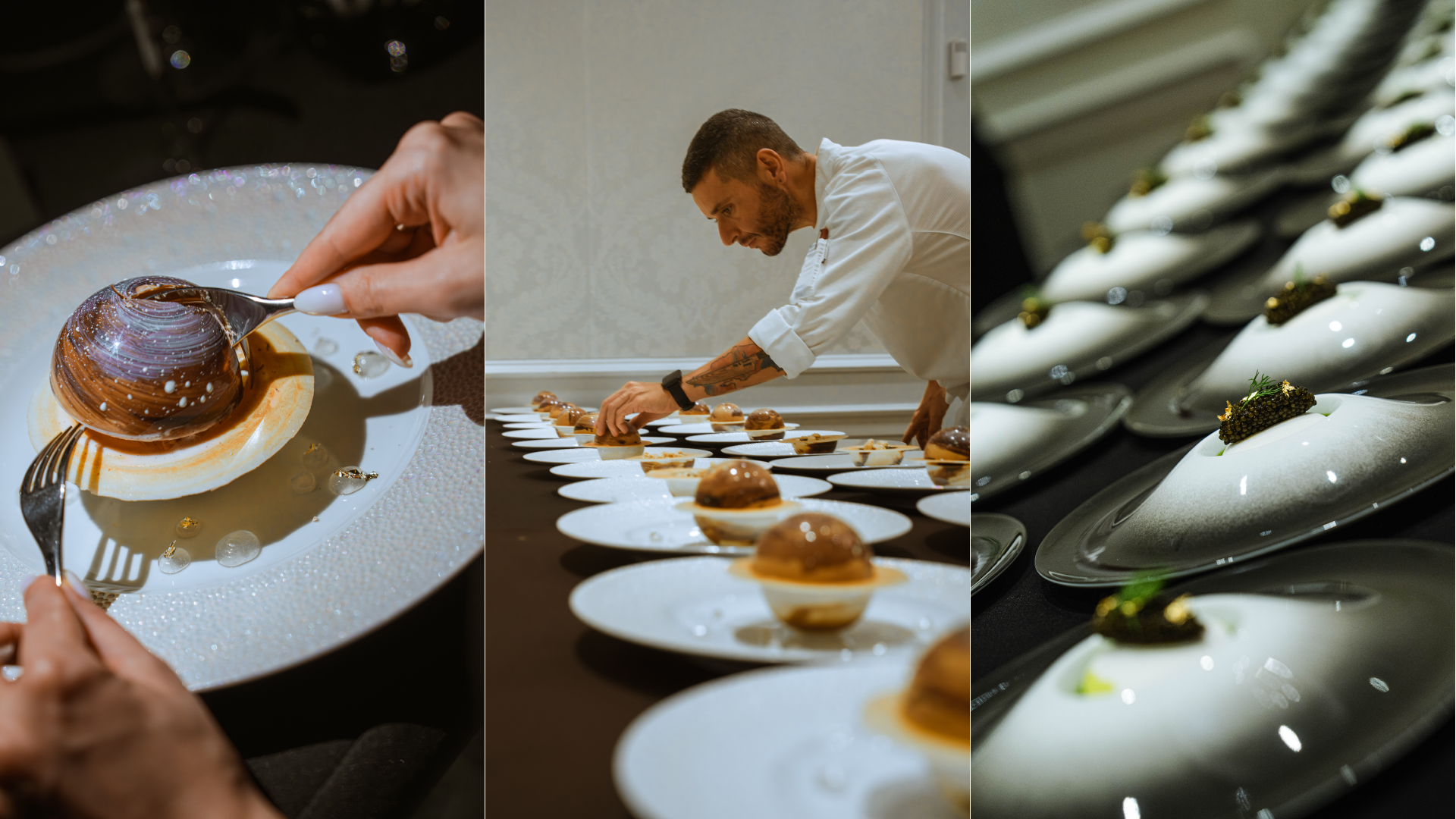
Yes sure, the activation was conceived as an intimate, high profile evening for a select group of guests, where art, cosmology and gastronomy could come together in a meaningful way. Tracing the Void is an immersive installation built around nearly 50,000 points of light that respond to the subtlest movement within the space.
The work draws inspiration from NASA’s space telescope imagery of the Milky Way’s core. I carefully translate these celestial visuals into studio perforated canvases, capturing what appears to be the beautiful chaos of the night sky. As the multiple layers interact, they create a 3D moiré effect where stars seem to shimmer and fade in response to the viewer’s movement, creating a sense of depth and quiet motion.
For me, the intention is to recreate the sensation of looking up at the heavens and to explore the mysterious space that exists beyond the surface of the canvas. I’ve always been drawn to that metaphysical idea of the edge of existence. When we study the sky, we are reminded of something much larger than ourselves. It is a feeling many people recognise in remote places, at sea, in rainforests, or under vast desert skies, where nature reveals its scale and a sense of transcendence begins to take shape.
Beyond the canvas and the prisms, you’ve also founded Platform Earth. How does environmentalism fit into your work?
Well, I like to say that I’m a frustrated architect and a committed environmentalist. Platform Earth was created to bridge the gap between charity art and high curation. We explore carbon negative materials and think about how art can function as a carbon sink. Whether it’s designing a walkway over the Venetian lagoons or developing new carbon neutral mediums, I believe art must confront the physical reality of our planet and the environment we inhabit.